

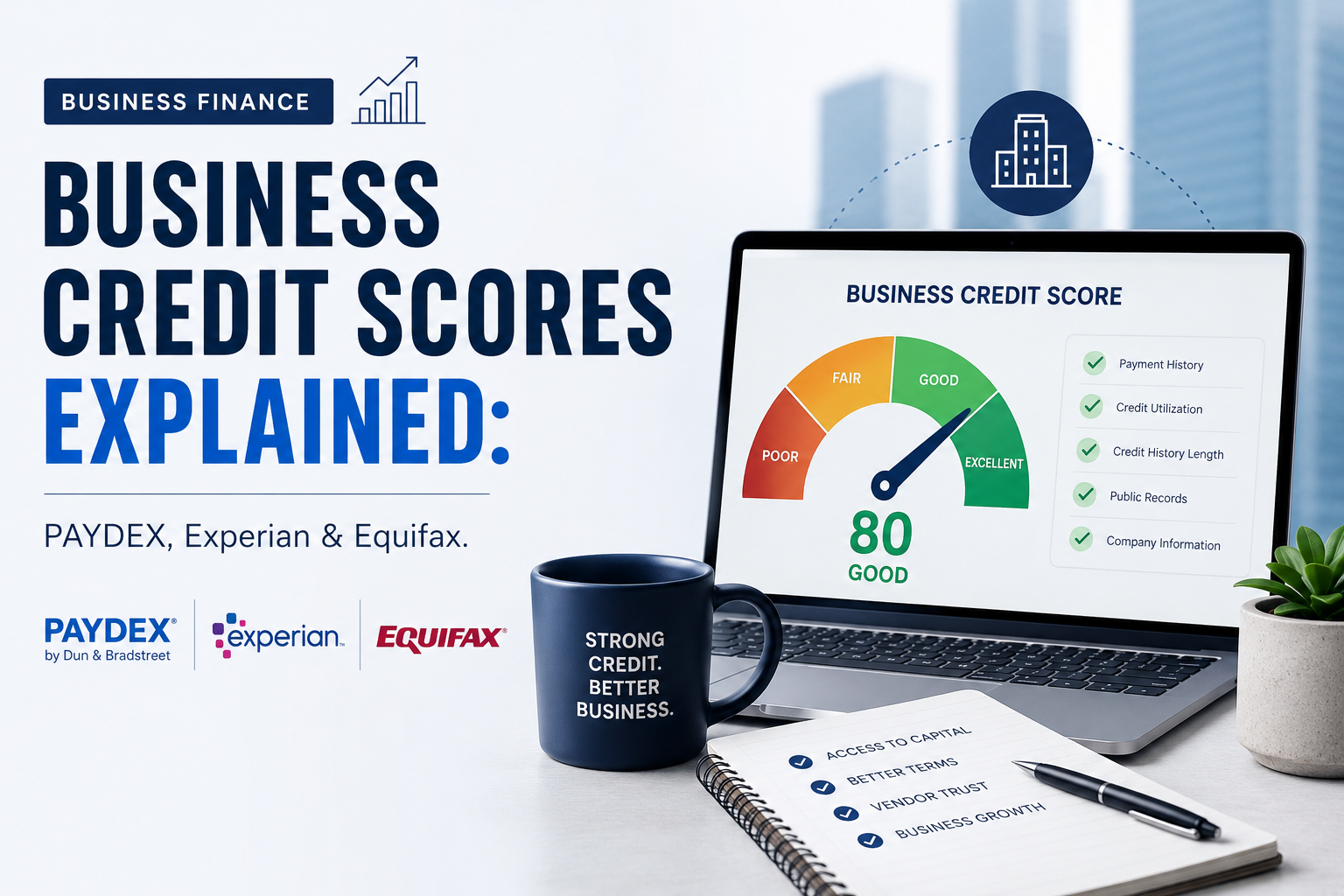
When you’re looking to secure commercial funding, expand your operations, or negotiate better terms with suppliers, your personal credit score is only half the battle. Lenders and vendors rely heavily on your business credit score to determine your company’s financial reliability and risk level.
Unlike consumer credit, which is standardized around the FICO model (ranging from 300 to 850), business credit is fragmented. The three major commercial credit bureaus Dun & Bradstreet (D&B), Experian, and Equifax each use entirely different scoring models, scales, and data points.
If you want to position your business for top-tier commercial funding, you need to understand how each of these scores works and what you can do to optimize them.
1. Dun & Bradstreet: The PAYDEX Score
Dun & Bradstreet is the oldest and most widely recognized business credit bureau. To even get on their radar, you must first register for a D-U-N-S® Number, a unique nine-digit identifier for your business.
Their primary scoring model is the PAYDEX Score, which strictly measures your past payment performance.
- The Scale: 1 to 100.
- The Target: 80 or above.
- How it Works: A score of 80 means you consistently pay your bills exactly on time. Interestingly, to score above an 80 (up to 100), you must consistently pay your bills early sometimes up to 30 days before the terms specify.
- Why it Matters: The PAYDEX is heavily dollar-weighted. This means a late payment on a $10,000 invoice will damage your score much more severely than a late payment on a $100 utility bill. Suppliers and vendors check this score religiously before offering Net-30 or Net-60 payment terms.
2. Experian: Intelliscore Plus
Experian’s commercial scoring model is highly predictive, designed specifically to tell lenders the likelihood of your business becoming seriously delinquent (90+ days past due) or filing for bankruptcy within the next 12 to 24 months.
They offer a few different models, but the most prominent is Intelliscore Plus.
- The Scale: The original and V2 models range from 1 to 100. The newer V3 model ranges from 300 to 850, intentionally mirroring the consumer credit scale.
- The Target: On the 1-100 scale, a score of 80+ is considered low risk. On the V3 scale, lenders look for scores in the upper tiers (typically 700+).
- How it Works: Experian blends over 800 commercial and owner variables. They look at your tradeline payment history, recent credit inquiries, public filings (like liens or judgments), collections, and key financial ratios.
- Why it Matters: Experian often offers a “blended data” option that incorporates both your business data and the owner’s personal credit data. This is particularly crucial for smaller operations or single-member LLCs seeking commercial loans.
3. Equifax: Business Credit Scores
Equifax takes a highly granular approach, breaking your business credit profile into several distinct scores rather than relying on just one overarching number.
- Equifax Business Delinquency Score (101–662): Predicts the likelihood of severe delinquency. Higher scores mean lower risk.
- Equifax Business Credit Risk Score (101–992): Evaluates credit history, utilization, and financial indicators to estimate the probability of general delinquency. Scores of 700+ are generally considered lower risk.
- Equifax Business Failure Score (1,000–1,880): Predicts the likelihood of the business closing its doors in the next 12 months.
- How it Works: Equifax relies heavily on banking data, lease agreements, and credit utilization (how much debt you have compared to your limits).
- Why it Matters: Traditional banks and institutional commercial lenders lean heavily on Equifax when underwriting substantial equipment financing, commercial real estate loans, or large lines of credit.
To make comparing these distinct models easier, explore this interactive breakdown:
Key insight: Because each bureau values different financial behaviors, a business can have an excellent PAYDEX score but a mediocre Equifax score if their credit utilization is too high.
Actionable Steps to Build Your Business Credit for Commercial Funding
Securing top-tier commercial funding requires intentional credit management. Here is how you can proactively shape your profile:
- Establish Your Foundation: Get your free D-U-N-S® number and ensure your business structure (LLC, S-Corp, etc.) is properly registered. Keep your business and personal finances entirely separate.
- Monitor Your Utilization: Just like personal credit, maxing out your business credit cards or lines of credit will drag down your Experian and Equifax scores. Aim to keep utilization below 30%.
- Establish Trade Lines: Open Net-30 accounts with vendors who explicitly report to D&B and Experian. Not all suppliers report automatically, so verify this before applying.
- Pay Early, Not Just On Time: If you want a top-tier PAYDEX score, paying on the due date isn’t enough. Automate your payments to clear a week or more before the deadline.
Your business credit score is your company’s financial resume. By actively managing how you look on paper to D&B, Experian, and Equifax, you open the door to higher limits, lower interest rates, and the capital necessary to scale.