

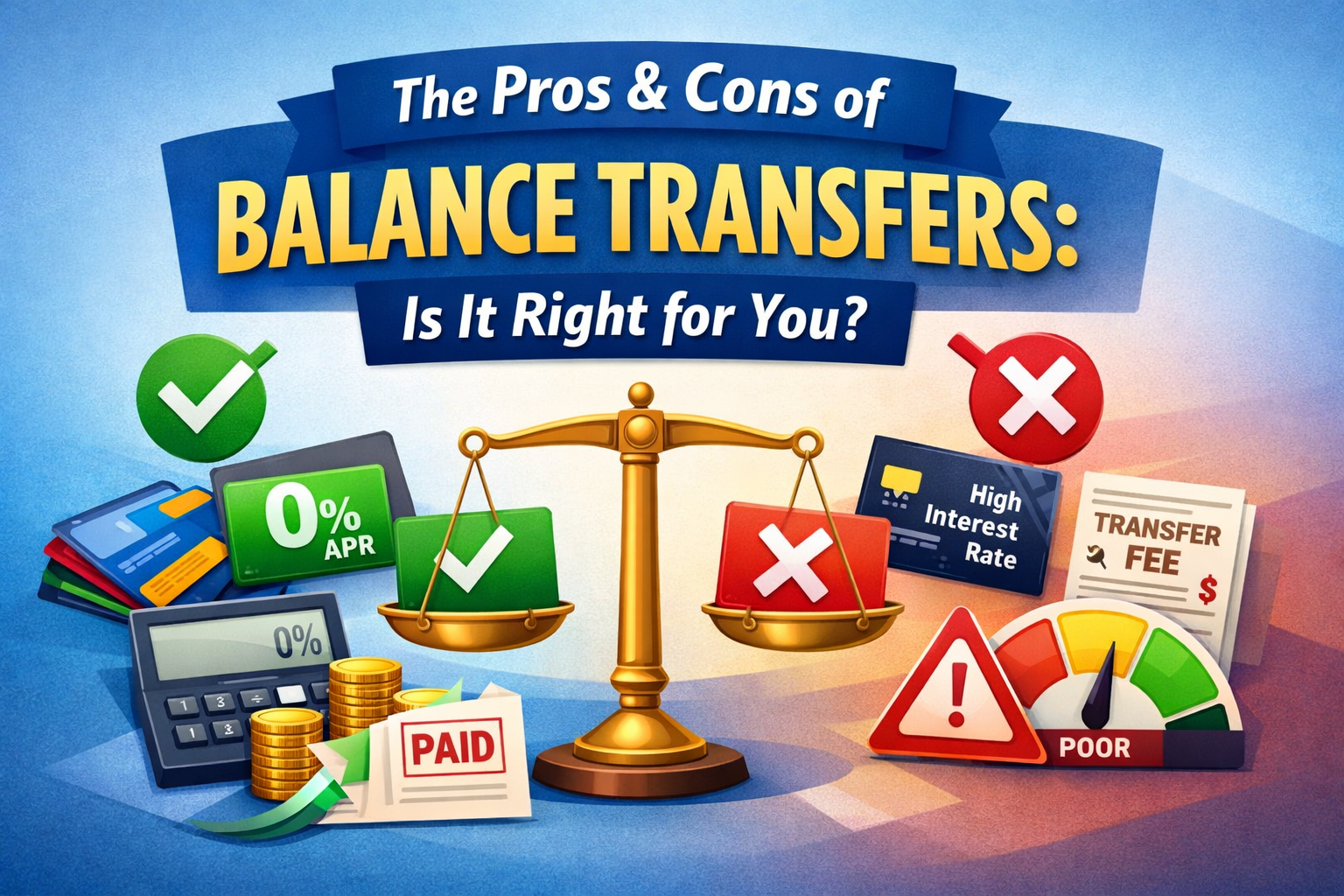
Credit card interest adding up faster than you can pay it down? You’re not alone. A balance transfer can feel like a lifeline—especially when you see those tempting 0% APR for 12–18 months offers. But before you make the move, it’s important to know exactly how balance transfers work, the benefits they offer, and the potential pitfalls.
This guide breaks everything down so you can decide with confidence whether a balance transfer is right for you.
What Is a Balance Transfer?
A balance transfer allows you to move high-interest credit card debt to another card—usually one offering a 0% APR promotional period. This gives you time to pay down the principal without constantly fighting interest charges.
Most common promotional periods:
- 6 months
- 12 months
- 15 months
- 18 months (some extend to 21 months)
Balance transfers are a popular tool for credit card debt consolidation, helping consumers lower monthly payments and become debt-free faster.
Pros of Balance Transfers
1. 0% APR Intro Period (Huge Interest Savings)
The biggest benefit is the ability to pay no interest for a set period.
- This allows every dollar you pay to reduce the principal.
- If you currently pay 20–29% interest, this can save hundreds—sometimes thousands.
Example:
$5,000 balance at 24% APR = ~$1,200 interest per year
Move that to 0% APR for 12 months → $0 interest
2. Consolidation Simplifies Payments
If you’re juggling multiple credit cards, a balance transfer lets you combine them into one account. This helps:
- Reduce missed payments
- Stay organized
- Manage payoff timelines more easily
3. Faster Debt Elimination
Because you’re not losing money to interest, you can:
- Pay down debt months faster
- Reduce total repayment dramatically
- Build financial momentum
Many people use 0% APR periods to aggressively eliminate debt.
4. Potential Credit Score Benefits
When used responsibly, balance transfers may benefit your credit score by:
- Lowering credit utilization
- Improving on-time payment history
- Reducing overall debt
Just avoid closing old accounts immediately.
Cons of Balance Transfers
1. Balance Transfer Fees
Most cards charge 3%–5% per transferred balance.
- A $5,000 transfer → $150–$250 fee
It’s still often worth it, but the cost must be factored in.
2. High APR After Promo Ends
Once the 0% period ends, the standard APR kicks in—often 20%–30%.
If you haven’t paid off the balance in time, interest can add up fast.
3. Requires Good to Excellent Credit
Top balance transfer deals usually require a 680+ credit score, though some lenders may approve with slightly lower scores.
4. New Purchases May Not Be at 0%
Some cards offer 0% APR only on transfers—not on new purchases.
New purchases can accrue interest immediately, making payoff harder.
5. Risk of Increasing Debt Again
Moving balances to a new card but continuing to use old cards can restart the debt cycle.
A balance transfer only works if you stop adding debt during the payoff period.
Is a Balance Transfer Right for You?
A balance transfer might be the right financial move if:
- You have high-interest credit card debt
- You can realistically pay off the balance during the promo period
- You qualify for a 0% APR offer
- You won’t accumulate new debt
- The transfer fee is less than the interest you’ll save
A balance transfer may not be ideal if:
- You have poor credit
- You can’t commit to paying off the balance within the promo period
- You’re prone to overspending
- The fee outweighs the benefits
Tips for Maximizing a Balance Transfer
1. Calculate the Real Cost
Compare the transfer fee vs. interest savings. In most cases, interest savings win.
2. Pay Off the Balance Before 0% Ends
Divide your total balance by the promo months. For example:
$5,000 ÷ 15 months ≈ $333 monthly payment
3. Avoid New Purchases
Keep the card strictly for payoff, not spending.
4. Keep Old Accounts Open
This helps your credit score by maintaining:
- Longer credit history
- Lower utilization
5. Set Up Automated Payments
Never miss a due date—one late payment can terminate the 0% APR offer.
Check Out These Other Guides!
- “How Credit Utilization Impacts Your Score”
- “Best Ways to Pay Off Debt Faster”
- “What Affects Your Credit Score?”
- “Understanding APR on Credit Cards”
- “Credit Card Mistakes to Avoid”
External Authority Sources
- Consumer Financial Protection Bureau (CFPB)
- Federal Trade Commission (FTC)
- FICO Monitoring Official Resources
Conclusion
A balance transfer can be a powerful tool to escape high-interest credit card debt—if used strategically. It offers interest-free breathing room, faster repayment, and increased financial stability. But it’s not a magic fix. To benefit, you must commit to paying off the balance and avoiding new debt.
Ready to improve your credit and take control of your finances?
If you need expert guidance, personalized strategies, or help rebuilding your credit, contact us today and move one step closer to financial freedom.
FAQs
1. Do balance transfers hurt your credit score?
A balance transfer may cause a small temporary drop due to the hard inquiry, but it can improve your score over time by lowering credit utilization.
2. How long does a 0% balance transfer last?
Typically 6–18 months, with some cards offering up to 21 months.
3. Can I transfer balances between cards from the same bank?
Usually no—most issuers don’t allow internal transfers.
4. Is there a limit on how much I can transfer?
Yes. Your available credit limit determines how much debt you can move.
5. What happens if I miss a payment?
Most issuers will cancel your 0% APR promo, and your rate may jump to the standard (or penalty) APR.